



In part two of Drug Target Review’s AACR 2026 coverage, we look at how oncology innovators are bridging the gap between complex biology and clinical impact across RAS targeting, immunotherapy, spatial biology and ADC development.
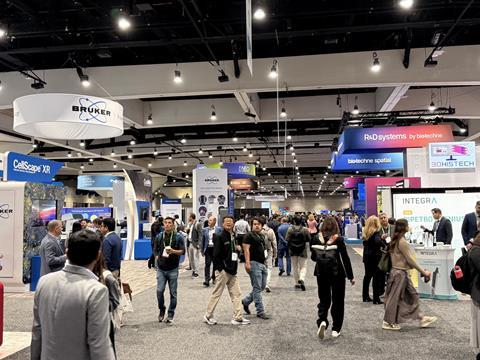
At the American Association for Cancer Research (AACR) Annual Meeting 2026, Drug Target Review continued its discussions with oncology drug developers, platform innovators and translational scientists exploring how automation, AI and increasingly sophisticated therapeutic modalities are helping to change experimental biology.
While part one focused on AI-driven discovery and molecular expansion of the druggable genome, part two highlights a different but connected challenge: how to translate increasingly complex biological systems – including spatial profiling, engineered proteins, cell therapies and combination strategies – into reproducible, clinically meaningful outcomes.
Across multiple conversations, experts explained how oncology is no longer constrained by the ability to generate data or design molecules, but by the ability to connect systems, standardise workflows and ensure that biological information survives the journey to the clinic.
RAS targeting and the shift towards combination logic
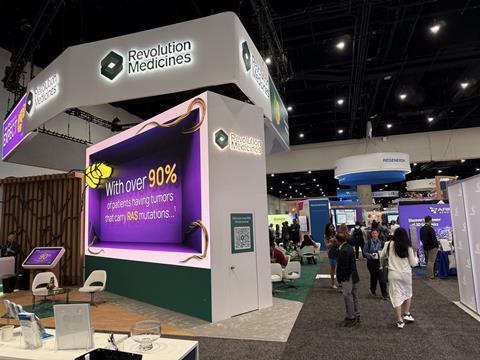
At Revolution Medicines, their focus is on one of oncology’s most historically intractable pathways: RAS. Chief Development Officer Alan Sandler described how the company’s emerging pipeline is already demonstrating differentiated activity in KRAS-driven cancers, including non-small cell lung cancer and pancreatic cancer.
Its KRAS G12D inhibitor has shown encouraging early clinical activity in previously treated NSCLC, including response rates significantly above historical standards of care and extended progression-free survival compared to chemotherapy.
“We’ve seen a median progression-free survival of just over 11 months compared to around four months with standard therapy,” Sandler said.
Beyond single-agent activity, Revolution Medicines is also looking at combination strategies. Sandler highlighted the biological rationale for combining RAS pathway inhibition with immunotherapy and other targeted agents.
“By inhibiting RAS, we may enhance immune system activity,” he explained.
This has led to the exploration of multi-agent regimens, including combinations of its RAS inhibitors with both immunotherapies and other targeted compounds, as well as progression into first-line pancreatic cancer studies.
TCR therapies and the expansion of immune targeting
At Immunocore, the conversation was focused on the evolution of T-cell receptor (TCR)-based therapies from niche applications into broader oncology platforms.
Dr Connie Pfeiffer, Head of Global Medical Affairs, highlighted five-year survival data from a pivotal study in metastatic uveal melanoma, a disease historically associated with extremely poor outcomes.
“The data shows a doubling of the proportion of patients alive at five years,” she said.
This long-term survival signal demonstrates the potential durability of TCR therapies in solid tumours, particularly when targeting intracellular antigens inaccessible to conventional antibody approaches.
Immunocore is also actively exploring combination strategies with their approved treatment and an investigational candidate in other types of cancer, particularly with checkpoint inhibitors such as pembrolizumab and nivolumab, while maintaining openness to other mechanistic partners.
“We’re not limiting ourselves to checkpoint inhibitors,” Pfeiffer said. “That’s one possibility, but we’re open to other mechanisms and our research and translational teams are always looking at what makes sense scientifically.”
From candidate selection to scalable development
While much of the focus at AACR was on breakthrough biology, several discussions highlighted that early development decisions – particularly in biologics – can have a lasting impact on clinical success.
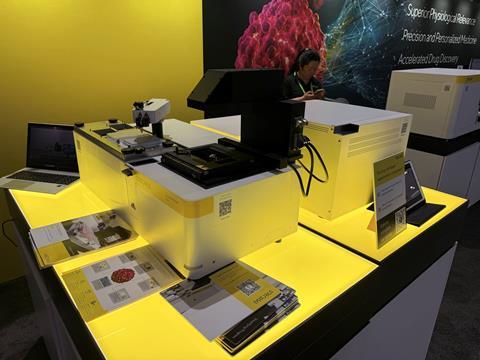
At Sartorius, Dr Darius Wilson, Sartorius Product Management, outlined how newer cell line development workflows are moving towards earlier, more data-driven selection of candidate clones. Platforms such as its CellCelector CLD Platform enable researchers to screen thousands of monoclonal-derived clones at the earliest stages, identifying top performers before committing resources to expansion and characterisation.
“The key advantage is the early preselection of top-performing clones from the largest possible pool,” he explained.
This approach is supported by integrated analytical validation across imaging, growth monitoring and productivity assays, helping ensure that accelerated timelines do not compromise clone stability or long-term output. By narrowing the field early, developers can avoid progressing suboptimal candidates, reducing both time and resource burden downstream.
The result is a more efficient and reliable transition from discovery into scalable development – an important factor as biologics pipelines continue to grow.
Engineering smarter biologics with next-generation discovery platforms
At Sygnature Discovery, attention was focused on how discovery platforms can change the design of next-generation therapeutics, particularly antibody–drug conjugates (ADCs).
Dr Allan Jordan, VP of Oncology Drug Discovery, described a field still dominated by a narrow set of cytotoxic payloads, limiting differentiation and increasing development redundancy.
“There are literally hundreds of very similar ADCs in development. There simply are not enough patients, or enough funding, for all of these to reach market and be commercially successful,” he said. “We are plotting a ‘new path’ forwards, where the antibody is only one component of the optimisation.”
To address this, Sygnature is advancing a more integrated design approach, focusing not only on antibody engineering but also on payload optimisation towards tumour-selective biology, including metabolic pathways and oncogenic dependencies.
Scaling biology with automation and data feedback loops
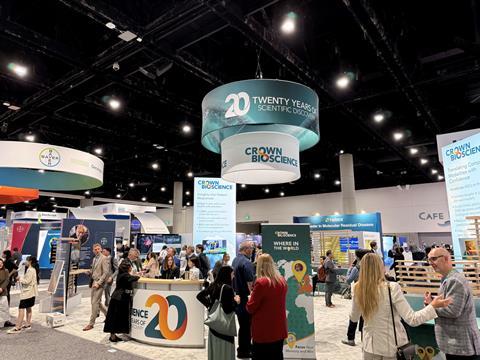
Crown Bioscience’s emphasis was on bridging experimental biology with AI-driven discovery systems.
CEO John Gu described a future in which preclinical models – including cell lines, organoids and patient-derived xenografts – are tightly integrated into iterative AI feedback loops.
“We see this as a lab-in-the-loop system,” he said.
In this model, AI generates hypotheses that are experimentally validated, with resulting data fed back to refine computational models. Crown’s role is to provide the biological validation layer required to ensure predictions reflect real tumour biology.
“It’s not just about prediction. It’s about validation,” Gu added.
Spatial biology and the challenge of multilayered data
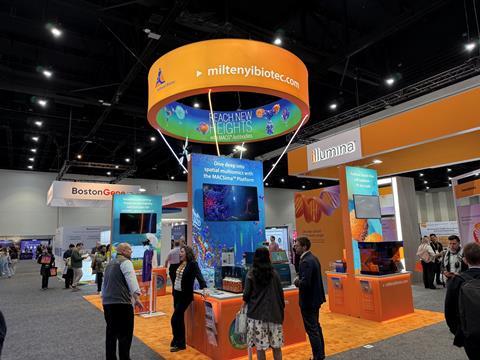
Miltenyi Biotec is rapidly advancing spatial biology technologies and attempting to understand what is possible in tissue analysis, while also addressing new challenges in data interpretation. With platforms now capable of analysing hundreds of proteins and RNA probes simultaneously, researchers can build increasingly detailed maps of tumour microenvironments, combining 3D tissue architecture with deep cellular phenotyping to understand biological organisation at multiple scales.
Yet this increased resolution is also shifting the bottleneck from data generation to data interpretation. As datasets become more multidimensional, the challenge is now about translating it into meaningful, ‘actionable insight’.
“With these technologies there is the potential to generate more data than actual actionable insight,” said Katrin Schönborn, Global Product Manager at Miltenyi Biotec. “The way we as a company resolve this is by providing dedicated software solutions integrated into our platform that allows users to really understand their data in an intuitive manner, while still preserving the flexibility needed for expert users to interrogate results in depth or apply alternative analytical approaches.”
Companies are now increasingly investing in integrated software ecosystems designed not only to manage complex datasets, but to support interpretation at scale. These platforms aim to bridge the gap between raw data and biological understanding, which is a balancing act between standardisation of analysis workflows and the flexibility required to tackle specific scientific questions.
“It’s a problem the entire field is facing,” said Eike Geißmar, Marketing Product Manager at Miltenyi Biotec. “We haven’t yet come to a consensus in the community on how to handle these datasets, but quite optimistic that this will happen just as it did for other ground breaking technologies and in the meantime, we are actively fostering exchange between our users to move things forward.”
From experimental systems to integrated oncology pipelines
From RAS inhibition and TCR therapies to spatial biology and cell line optimisation, AACR demonstrated that the field is looking at building systems that not only generate biological understanding but can reliably convert that into real benefit for patients down the line.
The next challenge is now about ensuring new biology can be connected, standardised and executed at clinical scale going forwards.






No comments yet